View flipbook
 Download current issue
 Archives

 Salk Institute
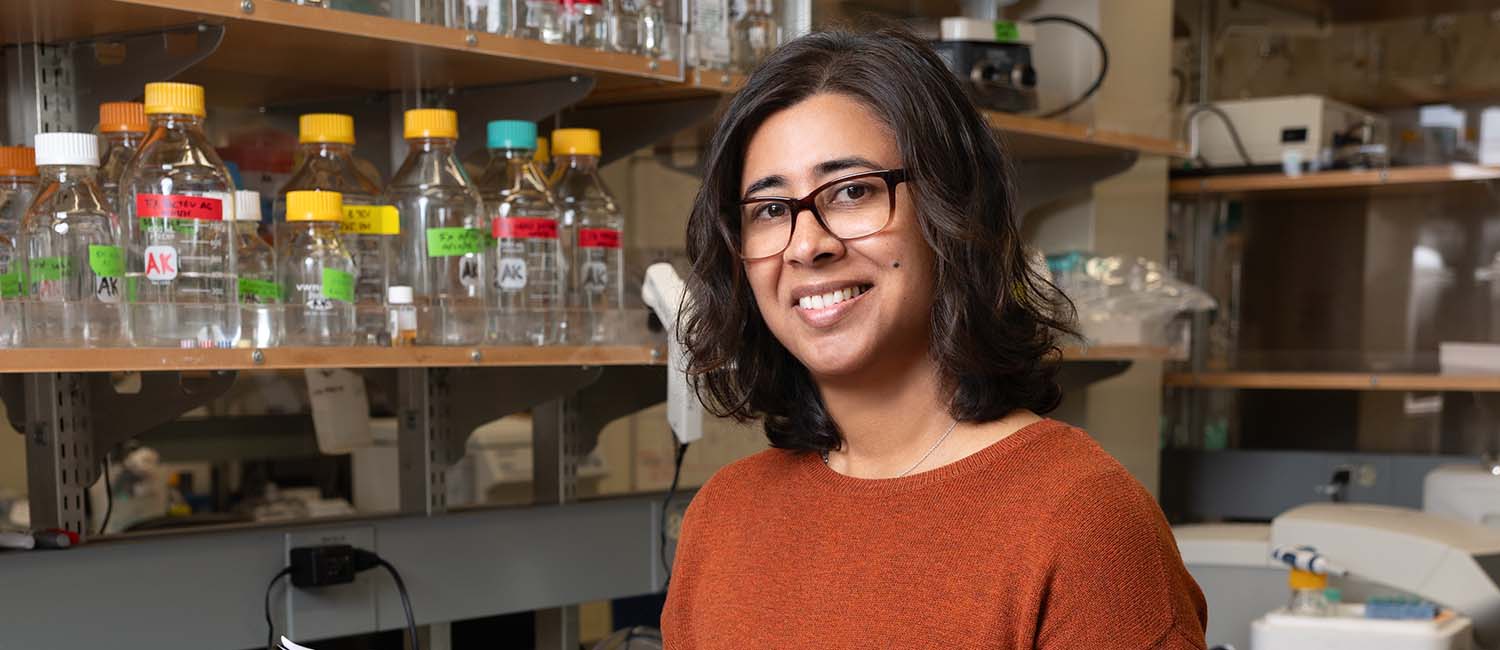
 Postdoctoral researcher Ankita Chadda, PhD, is enjoying a new sense of security in the lab of Agnieszka Kendrick, PhD, at Salk.
Chadda is studying microscopic cellular motors in Aga Kendrick’s lab.
“She’s very straightforward and very planned, which I like,” Chadda says of her faculty advisor. “We meet every week to discuss my plan for experiments and troubleshoot any issues that are coming up.”
Chadda is similar in nature, composed and pragmatic. But “straightforward” isn’t the word she’d use to describe her journey here.
Chadda grew up in Northwestern India in the rugged landscape of the Thar Desert. “I lived between camels and sand dunes,” she says. “It was a small town, and very, very dry.”
Her parents were both doctors and assumed she would follow in their footsteps, but Chadda was cautious about joining the family practice.
“My father was a psychiatrist, so there were always patients visiting the house, and that was hard to see at times,” she says. “But it did make me curious about the human mind and body and interested to understand what goes on inside us on a biochemical level.”
Chadda studied biology in college but didn’t have a clear plan for her career yet. In the years that followed, her personal life took the reins instead.
“I moved to South India with my husband, who was also in science,” says Chadda. “After that, we moved to Japan, and that’s when I became more exposed to research.”
Chadda, who was by then also a mother, got a job as a laboratory technician, preparing the necessary samples and tools to help the other scientists carry out their experiments.
When she relocated to the US, she was prepared to take on a similar role at the University of Iowa. But working in a smaller lab, Chadda soon found herself doing more than the typical technician.
“We didn’t have enough funding to hire more people, so the professor asked me to get more involved in the research,” she says. “I suddenly had the opportunity to do my own experiments, and I eventually got to publish a paper about my findings.”
This was a critical moment in Chadda’s self-discovery. For the first time, she was able to really see herself as a scientist. She had her own research questions, she was planning her own experiments, and she was ready for more.
“Most people go to graduate school right after college, but I had this 15-year gap,” she says. “I finally decided, though, ‘If I want to keep doing my science, I will have to get a PhD.’”
In 2018, Chadda made her biggest move yet. She left for St. Louis to start a PhD program in the Biochemistry and Molecular Biophysics department at Washington University.
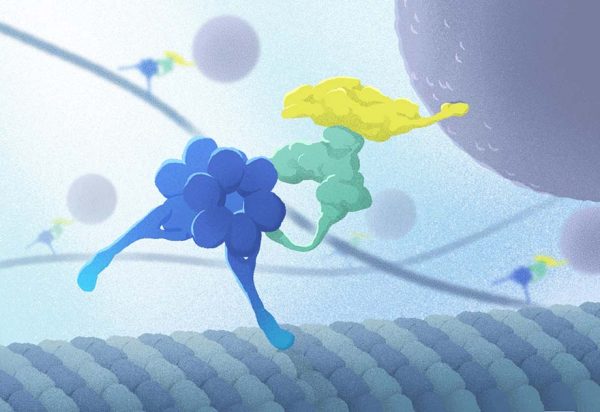
Over the next several years, Chadda dove deep into the world of protein mechanics. These skills led her to Kendrick’s lab at Salk, where she now studies motor proteins, tiny molecular machines that work like delivery trucks to transport cargo throughout our cells. She’s currently exploring the structure and function of dynein, a motor protein that plays an important role in brain health.
Dynein is responsible for transporting cargo from the outer edges of a cell back toward its central nucleus. In some extra-long nerve cells, this journey can be up to a meter long. So how does the cell ensure each package gets sent in the right direction?
Using cutting-edge cryo-electron microscopy, Chadda is filming dynein in action, capturing the tiny delivery truck in near-atomic resolution. The footage is revealing exactly how dynein interacts with other molecules to grab the right package and begin its journey back to the nucleus. The more we understand the mechanics of this process, the more smoothly we can keep it running as we age.
Onward and upward
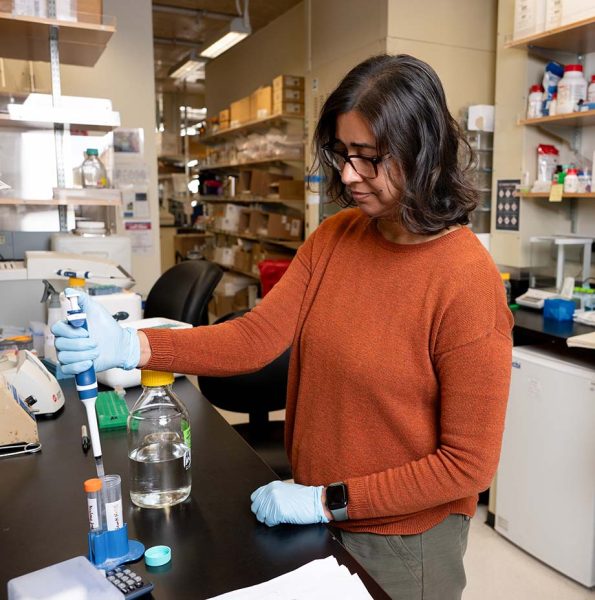
Dynein may be traveling backward, but Chadda continues to move forward.
As a postdoctoral researcher at Salk, Chadda has more scientific freedom than ever before. She designs her own experiments, manages collaborations across labs, and mentors younger students and technicians.
But this new autonomy also comes with added pressure. Unlike graduate students, postdoctoral researchers must often secure their own funding. Chadda estimates that applying for fellowships can take 15 or more hours of a postdoctoral researcher’s week.
That’s why philanthropic support for postdoctoral researchers is so important. Chadda is the inaugural recipient of the La Mer Fellowship in Healthy Aging. Through this fellowship, La Mer’s backing makes it possible for Chadda to pursue the foundational questions that move the field forward.
These days, Chadda is embracing her independence both in and out of the lab, enjoying life in sunny San Diego as her son finishes college back in St. Louis.
“I wanted him to go into research,” she says with a smile, “but he’s studying computer science. He’s not sure what he’ll do next, though.”
If he follows his mother’s brave example, he is sure to find his way forward.