View flipbook
 Download current issue
 Archives


 Salk Institute
 Salk’s donor-funded innovation and collaboration grants bring risky but rewarding science out of the dark
Salk’s donor-funded Innovation and Collaboration Grants bring risky but rewarding science out of the dark.
Pancreatic cancer is among the deadliest cancers and is projected to be the deadliest by 2030. Of the nearly 70,000 patients diagnosed annually in the US, only 13 percent survive five years post-diagnosis. While the number of people diagnosed with pancreatic cancer continues to rise each year, mortality rates have stayed the same. This is due in part to the minimal symptoms in the early stages of the disease, which hinder early diagnosis and give the cancer time to metastasize. These statistics weigh heavily on Salk cancer researcher Dannielle Engle, PhD.
Engle is constantly asking what drives the disease and how to stop it, with the aim of tackling pancreatic cancer and improving patient lives. But making a real change often means taking significant risks—risks that most funders are not willing to take.
“Working in a field with very poor patient outcomes, you want to chase transformative ideas. But there’s a constant pressure to stay safe and incremental in order to secure federal grants, which are continually more and more challenging to get,” says Engle.
The National Institutes of Health (NIH) is the primary funder of biomedical science in the US. Its support dwarfs all other contributors, providing around 80 percent of the funds for critical research projects, with an annual budget between $40 billion and $50 billion over the past decade. Other federal funders, such as the National Science Foundation and Department of Defense, provide additional billions, and private philanthropy adds billions more.
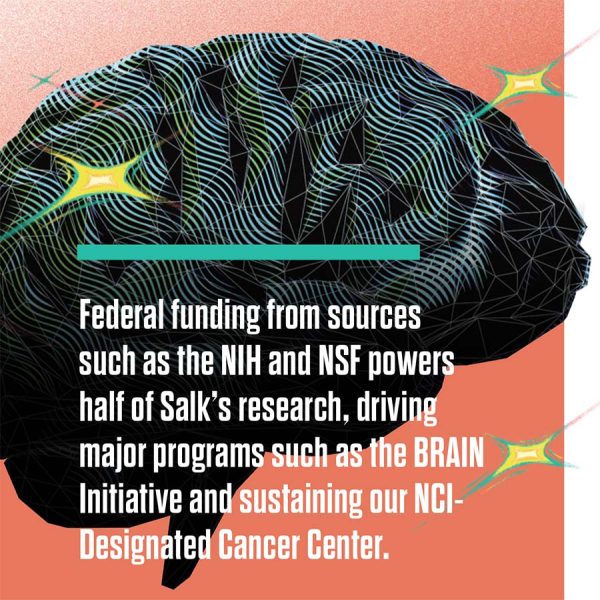
Federal funding supports half of all Salk science. These funds have made many discoveries possible, including monumental collaborations such as the NIH’s Brain Research Through Advancing Innovative Neurotechnologies® (BRAIN) Initiative, which ultimately aims to produce a new, dynamic picture of mammalian brains. They also support our cancer research, as Salk was named one of the first National Cancer Institute (NCI)-Designated Cancer Centers back in 1973. We still hold this special designation today as one of just seven such centers in the country dedicated to foundational cancer research.
Federal funding has been instrumental in carrying out Salk science for decades, but the projects it pays for almost always require substantial preliminary data. This important safeguard, among others, ensures taxpayer dollars are spent on high-quality, evidence-based ideas. However, over time, this cautious investment strategy means that most of the funding goes to incremental or follow-up studies. This leaves a critical gap in funding for new early-stage ideas and risks drying up the pipeline for future innovation.
While the NIH does offer high-risk, high-reward funding mechanisms, these opportunities represent only 0.5 percent of its total awarded grants, a number that has dropped between 2024 and 2025.
Salk researchers also face another challenging trend: Foundational research has been on the decline. In part, this can be traced to foundational science often being first on the chopping block when the time comes to cut costs. While rejecting early-stage research and risky questions is often the safer bet, it narrows the window of discovery in the long term.
The Salk Institute is keenly aware of the delayed gratification that comes with investing in bold, blue-sky science. When Tony Hunter, PhD, first asked how viruses turn healthy cells into cancer cells, the Institute didn’t hesitate to support the foundational studies that led to his discovery of tyrosine phosphorylation as a new cancer mechanism. Decades later, 80 different cancer drugs exist thanks to his seminal findings.
It would be difficult for the federal government to take a risk on finding the answer to a question such as Hunter’s with no immediate translational application. And yet, the outcome is clear. So, how can we ensure potentially lifesaving science is not left in the dark?
Philanthropy can light the way
Where federal funding falls short, philanthropy can fill the gap. Private donations do the important work of funding interdisciplinary science that does not neatly fit into the boxes the NIH or other federal agencies provide. This investment complements that of the federal government and thus maximizes monetary impact. Prioritizing higher-risk research can take that impact to the next level.
This is not news for Irwin Jacobs, ScD, scientist and entrepreneur turned philanthropist. Alongside his late wife, Joan, Irwin Jacobs moved from Boston to San Diego shortly after Salk was established. He taught for many years across the street at UC San Diego, then left for industry and ultimately set the standard for cellular technology when he co-founded Qualcomm in 1985.
But Jacobs had been eyeing Salk since his first visit in 1965. So, when he left his CEO position at Qualcomm in 2006, he became chair of Salk’s Board of Trustees.
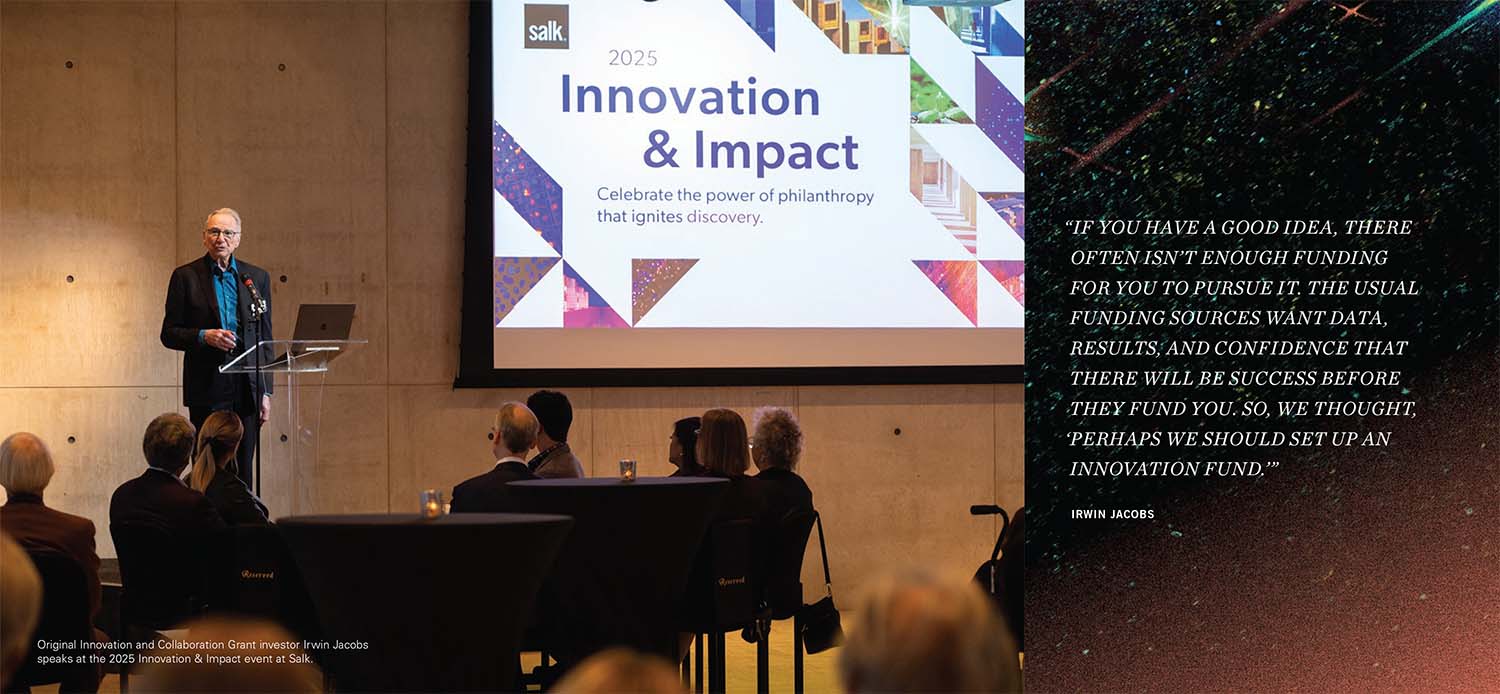
“Very shortly after becoming chair, I got to chatting with a more senior faculty member about potential issues that may arise during my chairmanship,” says Jacobs. “One of them was that if you have a good idea, there often isn’t enough funding for you to pursue it. The usual funding sources want data, results, and confidence that there will be success before they fund you. So, we thought, ‘Perhaps we should set up an innovation fund.’”
The plan was simple. Twice a year, Salk faculty members could put together short proposals describing their shot-in-the-dark ideas. Then, other faculty would assess the proposals and select which to support that round. With any luck, these new ideas could spark something bigger, lighting a path to larger grants from external funders who would have once turned the project down.
Jacobs believed so much in this initiative that he immediately donated the funds to make it happen. By December 2006, the first Innovation Grant was awarded.
Innovation Grants
“When we say innovation, we’re talking deep innovation— the ‘what ifs,’” says Salk President Gerald Joyce, MD, PhD. “And we expect that some of these projects will fail. Otherwise, we just aren’t taking enough risk.”
How do you assess a proposal that has a risk of failure to make it worth it?
That’s a question for Salk Chief Science Officer Jan Karlseder, PhD. Reviewers break their Innovation Grant assessment into three parts, he explains.
First, innovation: Is the idea creative and bold enough to transform existing research or open an entirely new research avenue? Second, impact: Could the proposed research have sustained scientific impact and address important problems? And finally, value: With this grant funding, can the project get the legs it needs to pursue external funding?
“We are looking for bold, transformative, new directions, with an emphasis on innovation over proven feasibility,” says Karlseder. “Unlike external grants, we discourage proposals that are obvious, next-step extensions of ongoing research. We want high-risk, high-reward projects that are unlikely to receive external funding.”
The ultimate goal is for this relatively small internal grant to generate the data needed to secure that external funding. When they are invested in risky what-ifs, these seed grants enable researchers to gather the preliminary data they need to become competitive applicants for the larger awards.
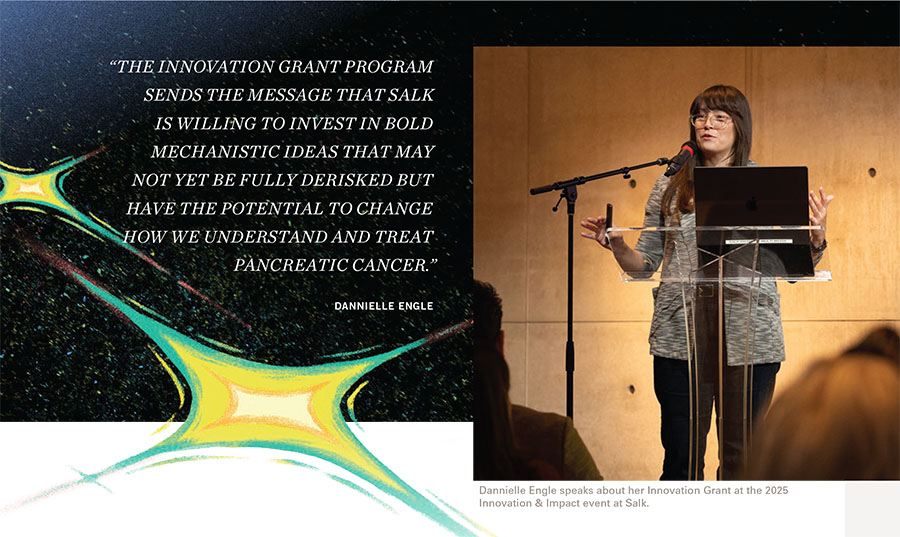
And that’s the chance they took on Engle’s research. “This funding came at a really critical time in my career,” she says. “Without the Salk Innovation Grant, this idea would have been lost.”
Patients with pancreatic cancer give blood samples to track their treatment progress, and Engle noticed something interesting in those samples. A sugar molecule called CA19-9 increased when tumors grew and decreased when tumors shrank. From there came her “what-if” question: What if CA19-9 helps pancreatic tumors grow and spread throughout the body?
Engle found that CA19-9 helps cancer cells leave the pancreas. This metastasis process is what kills patients, and Engle showed that blocking CA19-9 significantly slows metastases.
But she’s not stopping there. Engle recently submitted another grant proposal to extend the findings to other diseases, such as pancreatic inflammation. Her original question has illuminated an entirely new therapeutic area focused on targeting cell-surface sugars like CA19-9.
“The Innovation Grant program sends the message that Salk is willing to invest in bold mechanistic ideas that may not yet be fully derisked but have the potential to change how we understand and treat pancreatic cancer,” explains Engle. “Knowing that Salk and its supporters are willing to back this kind of high-risk, high-reward science has given both myself and my team the confidence that we can pursue these questions that we otherwise would have to put aside.”
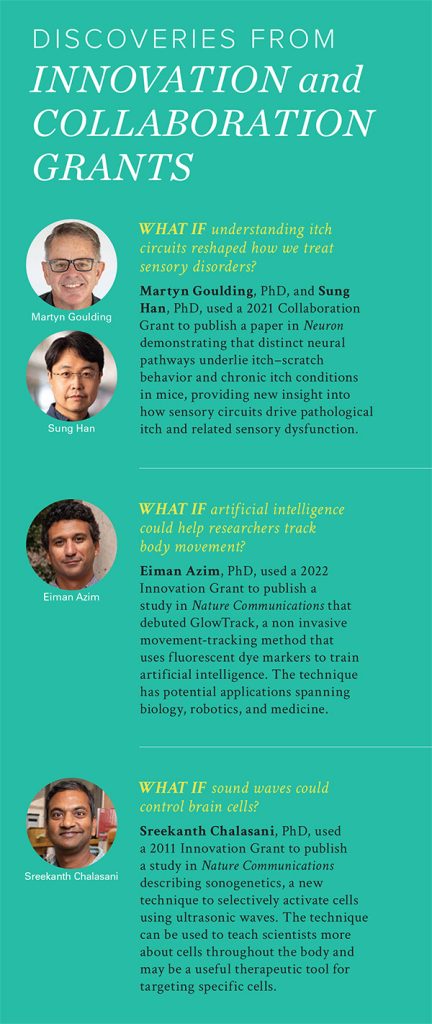
Since 2020, Engle has raised $1.5 million for this work— 15 times the original Innovation Grant award. And she’s not the only success story. Hunter, whose foundational exploratory research led to numerous cancer drugs, earned his own Innovation Grant in 2011 for a project on an entirely different topic.
Donor-funded Innovation and Collaboration Grants have helped Salk researchers secure millions of dollars in external funding, lighting the way to discoveries, inventions, and therapeutics that have the capacity to change lives.
More success stories
Hunter wanted to develop a tool to detect and understand histidine phosphorylation, another protein modification linked to cancer. He managed an impressive 111:1 leveraging ratio on the original Innovation Grant investment, receiving $10 million total to develop his tool, which has now reshaped the cancer treatment landscape and continues to inform new therapeutic strategies.
Another tool that started with an Innovation Grant came from the lab of Sreekanth Chalasani, PhD. Chalasani used his 2011 seed money to develop sonogenetics, a noninvasive technology for stimulating neuronal activity. He envisions this technique could one day be used to treat neurological conditions such as Parkinson’s disease.
Since the original grant, Chalasani has spun out a startup company, SonoNeu, to get sonogenetics out in the world, helping patients. And in spring 2026, he received an up to $41.3 million award from the Advanced Research Projects Agency for Health (ARPA-H), an agency within the United States Department of Health and Human Services, to further explore potential clinical applications for sonogenetics.
Salk’s monumental Harnessing Plants Initiative also started with an Innovation Grant. The Initiative is optimizing plants to support food security, resilient agriculture, carbon capture, and coastal restoration.
The 2017 award helped the Initiative’s founding director, Joanne Chory, PhD, earn an incredible $35 million TED Audacious Award, which has since supported several plant biology labs across the Institute.
Collaboration Grants
After 13 years of success with the Innovation Grant program, the Collaboration Grant program was born.
Collaboration is physically built into Salk’s campus. The absence of maps and signage encourages conversation, while open-concept labs and shared core facilities foster connection. Given this omnipresence of interdisciplinarity and interrelation, the 2019 launch of the Collaboration Grant program seems inevitable.
As with Innovation Grants, Collaboration Grant applicants must ask bold, risky questions. Their proposals are judged by similar metrics—innovation, impact, and value are all still on the scorecard. One new metric, collaboration, differentiates these grants. How strong is this team, and does their combined effort make sense in relation to the question they are asking?
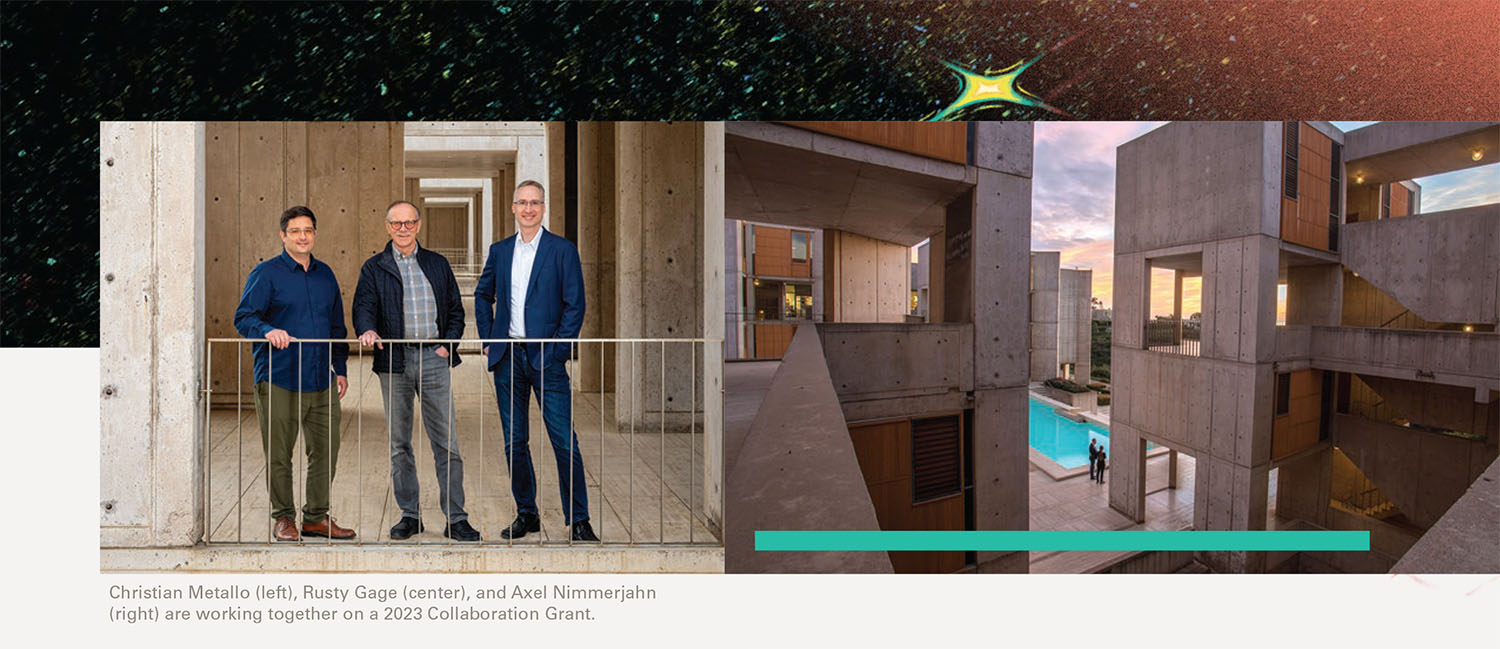
For Axel Nimmerjahn, PhD, Christian Metallo, PhD, and Rusty Gage, PhD, the answers to those questions are “Very strong” and “Yes.”
“This collaboration really grew out of a shared scientific curiosity and the environment at Salk that encourages people to talk across disciplines,” shares Nimmerjahn.
Nimmerjahn, a biologist and physicist, studies how cells in the brain and spinal cord coordinate their activity while also developing the tools needed to observe these processes in real time, such as miniature, high-resolution microscopes. For a long time, he has wondered why the central nervous system, normally remarkably resilient, begins to fail during infection or with age. The more he wondered, the clearer it became that this question was simply too big for one lab to answer alone.
Salk’s map-free design and open, shared labs are built to spark collaboration. Researchers meet in the mysterious darkness where disciplines such as neuroscience, metabolism, and immunology converge, then light the way to unexpected answers that transform our understanding of the world.
Using Nimmerjahn’s real-time imaging technology, Gage’s organoid models (3D collections of cells that mimic human tissue), and Metallo’s metabolic profiling, the team set out to create an atlas of the many states and stages that brain immune cells, called microglia, take on over a lifetime.
“At its core, the project asks a deceptively simple question,” explains Gage. “How do genetic, environmental, and aging factors converge to drive Alzheimer’s disease? We found that they all converge on microglia.”
The team was awarded a 2023 Collaboration Grant and has already published a paper in Cell, debuting a first-of-its-kind microglia-populated brain organoid. With that effort behind them, it was much easier to raise funds for their follow-up questions. The team has since raised $4.2 million, a 13-fold return on investment.
“Not only do we want to understand what turns microglia from helpful to harmful, but we also want to know whether we can intervene by preventing, reversing, or repairing those changes,” says Gage. “One approach we are testing is replacing or reprogramming microglia to restore brain health.”
Nimmerjahn notes that the implications will likely extend beyond Alzheimer’s. Because the work addresses fundamental immune mechanisms in the brain, the findings could inform many neurodegenerative and inflammatory diseases.
In addition to return on investment and human health applications, another measure of the program’s success is the number of repeat applicants, such as Metallo.
“These grants provide needed funding for exploring new ideas collaboratively with other scientists,” says Metallo. “By working with other teams, it makes the project stronger and more productive, and often more fun to execute!”
Two years after his first Collaboration Grant, Metallo teamed up with another Salk scientist, Janelle Ayres, PhD. Their 2025 proposal speaks to the flexibility of basic science—when you do foundational research, one day, you are working on a brain organoid and the next, you are developing a topical therapeutic.
“Christian’s lab made an exciting discovery about skin metabolism, and he wants to test his hypotheses in the context of skin infections,” explains Ayres. “My lab provides the infection expertise and laboratory models for him to test those hypotheses.”
Ayres and Metallo are investigating a new class of sphingolipids found in human skin, which they call “very long-chain sphingoid bases,” or VLCBs. These VLCBs seem to be reduced in patients with atopic dermatitis or eczema, which led the duo to ask: What if VLCB treatment could help with those conditions?
By bringing diverse expertise to the table, the interdisciplinary team members can ask questions none of them could answer on their own. “Plus,” Ayres adds, “I always look forward to working with Christian and his lab. They are great, and I learn a lot from them whenever we collaborate.”
Funded by one of the latest Collaboration Grants, their project represents the continued interest Salk faculty hold in the program. It also shows that interest is reciprocated, as their proposals remain worth investing in; their sparks remain worth igniting.
What if?
Twenty years have passed since the first Innovation Grant, and those what-ifs just keep coming.
“It’s even more important these days that we have these grants, because it’s even harder to get early support with the pressures at the federal level,” says Jacobs. “We are giving our researchers a chance to get their ideas and data together, so they have a real opportunity to secure external support.”
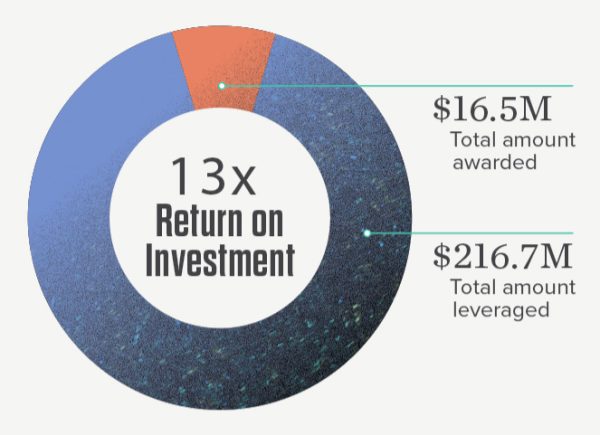
$16.5 million has been invested into 129 Innovation and Collaboration Grants. And each dollar was worth it— leveraged an average of 13-fold as faculty turned out-of-the-box thinking and early preliminary data into $216.7 million of follow-up funding.
Today, other donors have joined Jacobs in their generosity; Sarah and Jay Flatley, Richard Heyman and Anne Daigle, and the NOMIS Foundation all support these risky, rewarding grants. This monetary support has enabled Salk researchers to ask and answer questions with research that would not be funded by more conservative, disciplinarily siloed federal grants.
“Especially when it comes to disease-related questions, collaboration is essential,” says Nimmerjahn. “These are complicated questions that need diverse expertise and a considerable toolbox. That’s where the strength of Salk comes in.”
Innovation and collaboration are crucial components of modern science everywhere, but they are inextricable from the Salk Institute’s mission.
“This Salk program embodies our culture of scientific boldness and innovation,” says Karlseder. “It also demonstrates Salk’s investment in its researchers’ long-term success by providing seed funding that positions them to compete for major external grants and pursue ambitious, field-defining research.”
The Innovation and Collaboration Grant program is uniquely Salk. Scientists are attracted to the Institute for its emphasis on foundational, exploratory research and its insistence on relationship building and cross-disciplinary idea-sharing in the iconic Courtyard, over coffee, or across the lab bench.
“We talk to each other, and we know each other,” says Nimmerjahn. “We feel comfortable discussing these ideas. That makes it much easier to say, ‘Hey, what if?’ Then, with this grant support, we can actually give those ideas a try. And sure, there’s always a chance some of them won’t work, but if even a few do, they can pay off in a really big way.”