











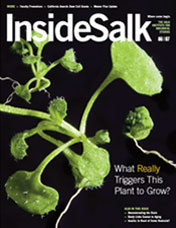


In the bustling setting of the cell, proteins encounter each other by the thousands. Despite the hubbub, each one manages to selectively interact with just the right partners thanks to specific contact regions on its surface. However, these regions have remained far more mysterious than might be expected, especially given decades of research into protein structure and function. Salk Professor Vicki Lundblad and co–first authors John Lubin and Timothy Tucey, now at Monash University, developed a new method to discover which surface contacts on proteins are critical for these cellular interactions. Their approach shows that essential new functions can be uncovered even for well-studied proteins, and has significant implications for therapeutic drug development, which depends heavily on how drugs physically interact with their cellular targets. The paper appeared in the early-access online version of Genetics on November 29, 2017.
Immune cell policing offers insights into cancer, autoimmune disease
Featured Stories
 The future starts upstreamFoundational discoveries are the source of tomorrow’s breakthroughs, but what happens if we let the river run dry?
 Diana Hargreaves: Follow the ScienceThe BAF complex is near and dear to Diana Hargreaves, PhD, a scientist, professor, and the J.W. Kieckhefer Foundation Chair at Salk. Hargreaves was born in Atlanta, Georgia, to a physician-scientist mother, so science had a hold on her from the very beginning.
 Ana Cabrera: Clearing the Path to DiscoveryCabrera is the senior director of strategic operations at Salk, a right-hand role to Chief Science Officer (CSO) Jan Karlseder, PhD. Cabrera and her colleagues in the CSO’s Office support Salk scientists through all of the logistical challenges that stand between them and their potential.
 Aksinya Derevyanko: Finding strength in science, stage, and synapsesDerevyanko is a postdoctoral researcher training under Nicola Allen, PhD, a professor and neuroscientist at Salk.