




Next Gen Aksinya Derevyanko Finding strength in science, stage, and synapses
Aksinya Derevyanko, PhD, was only 13 years old when she started working long shifts at a gas station. Already a passionate academic and dancer, the teen quickly found herself searching for a more fulfilling career.
“It was a great experience and helped me understand the job market,” Derevyanko says. “I knew if I wanted to do something more creative, I had to prioritize my education.”
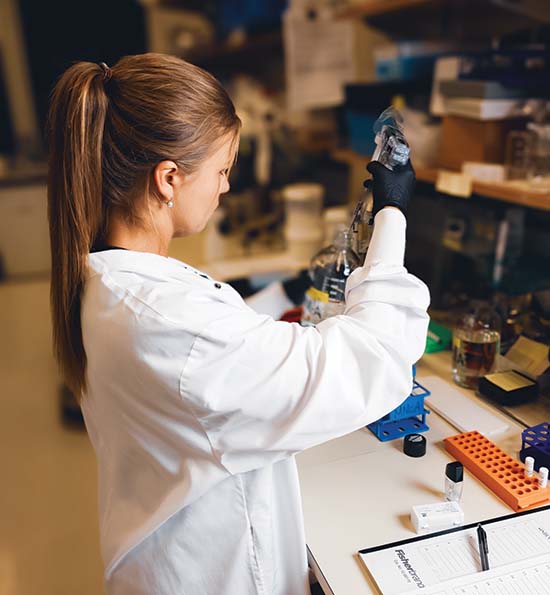
Today, Derevyanko is a postdoctoral researcher training under Nicola Allen, PhD, a professor and neuroscientist at Salk. Surrounded by a stimulating mix of neurobiologists, biochemists, and electrophysiologists, Derevyanko now spends her days studying synapses—the tiny junctions between neurons where messages travel from one cell to the next.
Education was always important in Derevyanko’s house and also in Russia at large, where it was both widely accessible and considered essential for one’s future.
“When the USSR collapsed, many institutions had to downsize,” Derevyanko explains. Many highly trained scientists turned to teaching. “Most of my teachers in high school were nuclear or plasma physicists.”
Derevyanko’s parents were also well educated. Her mother was a mathematician by training, and her father’s talents ranged from art to chemical engineering. When it came time for their daughter to go to university, both parents also went back to school for master’s degrees.
Derevyanko attended Novosibirsk State University, known for its strong science curriculum. While attending biology lectures and studying mushrooms in a lab, she slowly realized molecular biology was what excited her most. She decided to switch labs to join a group specializing in molecular biology and biochemistry, and it was during this time that she was first introduced to neuronal synapses.
Through education and science, new experiences and adventures were suddenly possible.
“I was given the opportunity to work in a lab near Paris in France, where I could see how a different, international institute works,” says Derevyanko. “I quickly realized that, for me, it is very important to have a variety of experiences in science and in life in general. So, I started to apply for fellowships abroad and ended up in Spain.”
In Spain, Derevyanko studied the molecular biology of telomeres. “Telomeres are these repetitive sequences that form caps on the end of your chromosomes,” she explains, “and I was mostly looking at telomeres in the context of aging, cancer, and neurodegeneration.”
Telomeres shorten or become damaged as we age, leaving the ends of our DNA exposed. When cells sense this, they sound their alarms and either enter apoptosis, a form of programmed cell death, or senescence, a harmful low-functional state. This loss of healthy cells and accumulation of senescent cells is a key research topic in the field of aging. Derevyanko’s interest in how this process affects the brain led her to Allen’s lab at Salk.
Allen is an expert on star-shaped brain cells called astrocytes. Among their many roles in brain health, astrocytes are crucial for regulating the stability and strength of synapses. Derevyanko studies a molecule that astrocytes release to help strengthen certain synapses. These synapses are weakened in Alzheimer’s disease, contributing to the memory loss and cognitive decline in Alzheimer’s patients. Derevyanko is investigating whether boosting this molecule could help rescue synaptic strength in the Alzheimer’s brain.
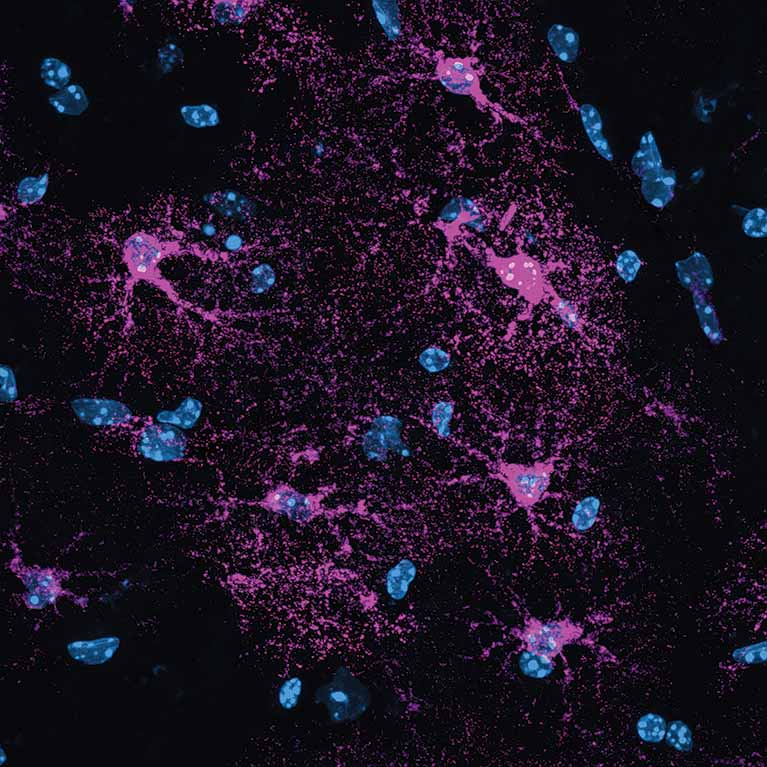
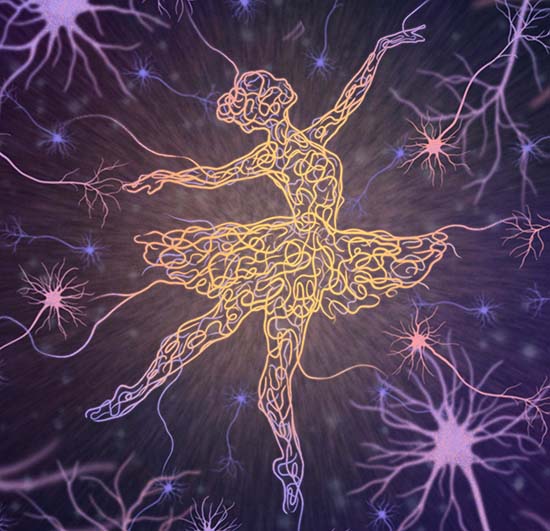
Derevyanko is investigating the overexpression of a synapse-regulating protein (magenta) in astrocytes.
“Our findings will be very important for translational research. Other neurodegenerative diseases also experience synapse loss, so our results can be applied to many conditions.”
-Aksinya Derevyanko
When she’s not at the lab bench, Derevyanko finds joy and expression through dance. Over the years, she’s extended her training beyond ballet into hip-hop, funk, breakdance, salsa, and bachata. Derevyanko is now living as a scientist and semiprofessional dancer, and learning never stops.
“I think dance helps me be a better scientist because both fields are very creative but also require a lot of mind work,” she says. “And when a hard experiment doesn’t work out or I can’t perfect a step in a dance routine, I can always just turn to the other to make me happy.”
Hear more from Aksinya Derevyanko, PhD, on Salk’s Beyond Lab Walls podcast, where she explains how the connections between our brain cells—called synapses—form, mature, and fail throughout our lifetimes and in diseases like Alzheimer’s.

Featured Stories
 The future starts upstreamFoundational discoveries are the source of tomorrow’s breakthroughs, but what happens if we let the river run dry?
 Diana Hargreaves: Follow the ScienceThe BAF complex is near and dear to Diana Hargreaves, PhD, a scientist, professor, and the J.W. Kieckhefer Foundation Chair at Salk. Hargreaves was born in Atlanta, Georgia, to a physician-scientist mother, so science had a hold on her from the very beginning.
 Ana Cabrera: Clearing the Path to DiscoveryCabrera is the senior director of strategic operations at Salk, a right-hand role to Chief Science Officer (CSO) Jan Karlseder, PhD. Cabrera and her colleagues in the CSO’s Office support Salk scientists through all of the logistical challenges that stand between them and their potential.
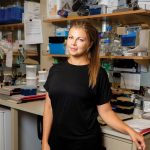 Aksinya Derevyanko: Finding strength in science, stage, and synapsesDerevyanko is a postdoctoral researcher training under Nicola Allen, PhD, a professor and neuroscientist at Salk.