












Discoveries
Cancer
Cancer
We are rapidly demystifying cancers, exposing the molecular mechanisms underlying tumors and leading the search for the next generation of targeted cancer therapies. We see a future where every cancer and every patient has a cure.

Discoveries

PROCEEDINGS OF THE NATIONAL ACADEMY OF SCIENCES
07/2025

How does an injury turn into agony?

Pain isn’t just a physical sensation—it also carries emotional weight. That distress, anguish, and anxiety can turn a fleeting injury into long-term suffering.

Salk neuroscientist Sung Han, PhD, senior research associate Sukjae Kang, PhD, and colleagues have now identified a brain circuit that gives physical pain its emotional tone, revealing a new potential target for treating chronic and affective pain conditions such as fibromyalgia, migraine, and post-traumatic stress disorder (PTSD). The study identifies a group of neurons in a central brain area called the thalamus that appears to mediate the emotional or affective side of pain in mice. This new pathway challenges the textbook understanding of how pain is processed in the brain and body.


NATURE IMMUNOLOGY
07/2025

How does the immune system prepare for breastfeeding?

Breastfeeding has known benefits for both mother and child, reducing maternal risk of breast and ovarian cancers, type 2 diabetes, and high blood pressure while simultaneously supporting the baby’s nutrition and immune system. But because pregnancy and lactation have been historically understudied, we still don’t understand the science behind many of these benefits.

Salk immunologist Deepshika Ramanan, PhD, graduate student Abigail Jaquish, and colleagues are changing that. In their latest study, they mapped the migration of maternal immune cells before and during lactation. Using both animal research and human milk and tissue samples, the researchers discovered that immune cells called T cells become abundant in the mammary glands during pregnancy and breastfeeding, with some relocating from the gut. The scientists are now studying how this immune cell migration supports maternal and infant health. Their continued findings may help explain the benefits of breastfeeding, prompt new solutions for mothers unable to breastfeed, and inform dietary decisions that enhance breast milk production and quality.

BMC METHODS
07/2025

Can an AI tool illuminate the “dark side” of the human genome?

Proteins sustain life as we know it, serving many important structural and functional roles throughout the body. However, these large molecules have cast a long shadow over a smaller subclass of proteins called microproteins. Lost in the 99 percent of our DNA that was previously disregarded as “noncoding,” microproteins have been hiding in these vast, dark stretches of unexplored genetic code. But despite being small and elusive, their impact may turn out to be just as big as that of larger proteins.

Salk scientist Alan Saghatelian, PhD, postdoctoral researcher Brendan Miller, PhD, and colleagues are now exploring the mysterious dark side of the genome in search of microproteins. Using their new AI tool called ShortStop, researchers can probe genetic databases and identify stretches of DNA that likely code for microproteins. Importantly, ShortStop also predicts which microproteins are most likely to be biologically relevant, saving time and money in the search for their role in health and disease. The Salk team has already used the tool to analyze a lung cancer dataset and found 210 entirely new microprotein candidates—with one validated standout—that could make good therapeutic targets in the future.

PROCEEDINGS OF THE NATIONAL ACADEMY OF SCIENCES
08/2025

Could microproteins be used to treat obesity?

The obesity rate has more than doubled in the last 30 years, affecting more than one billion people worldwide. Current treatment options include lifestyle interventions, bariatric surgery, and GLP-1 drugs like Ozempic or Wegovy, but many patients struggle to access or complete these treatments or to maintain their weight loss afterward.

Salk scientist Alan Saghatelian, PhD, postdoctoral researcher Victor Pai, PhD, and colleagues are paving the way for new treatment strategies by exploring the link between obesity and microproteins, a mysterious class of molecules found throughout the body. In a new study, the researchers screened thousands of fat cell genes using CRISPR gene editing tools and found dozens of genes that likely code for microproteins involved in regulating fat cell development or lipid accumulation. The findings identify new microproteins that could serve as potential drug targets for treating obesity and other metabolic disorders. The study also showcases the value of CRISPR screening in future microprotein discovery.

Nature Plants
08/2025

What can the plant life cycle teach us?

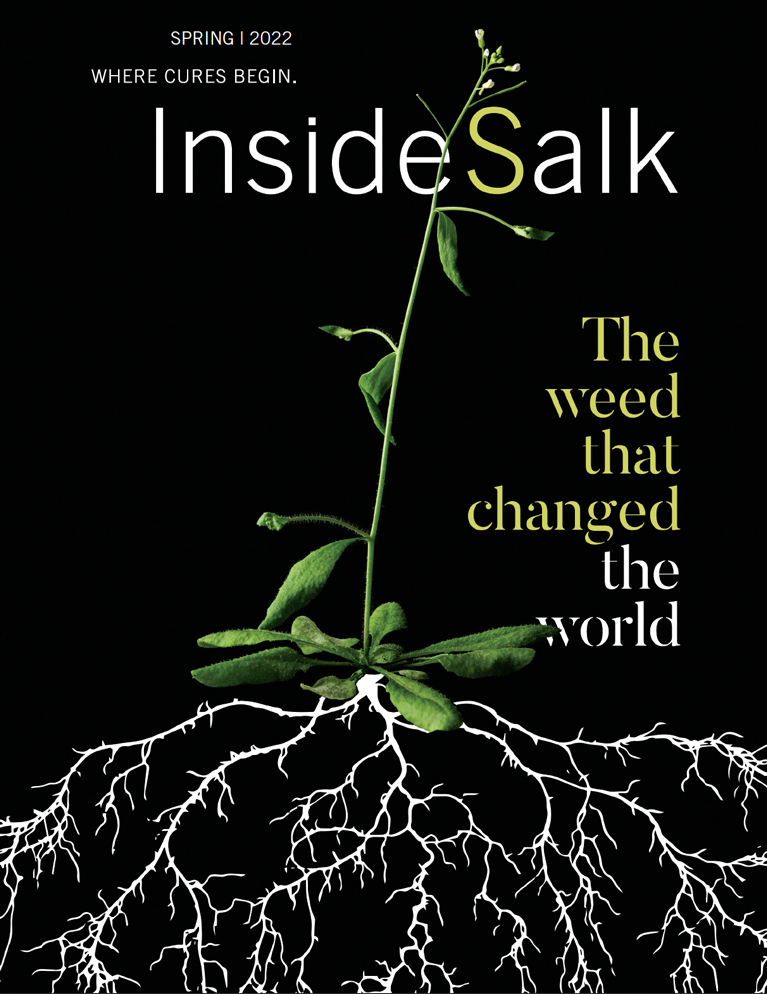
Nearly everything you know about plants was first discovered in a plant you’ve likely never heard of. Arabidopsis thaliana, also known as thale cress, is a small, flowering weed that has been used by researchers for the last half-century to study plant growth and behavior. Despite this, many aspects of the Arabidopsis life cycle still remain a mystery.

Salk scientist Joseph Ecker, PhD, postdoctoral researchers Natanella Illouz-Eliaz, PhD, and Travis Lee, PhD, and colleagues have now established the first genetic atlas to span the entire Arabidopsis life cycle. The new resource, created using detailed single-cell and spatial transcriptomics, captures the gene expression patterns of 400,000 cells within multiple developmental stages as Arabidopsis grows from a single seed to a mature plant. The public atlas will be highly informative for future studies of plant cell types, developmental stages, and responses to environmental stress. Those findings will then help expand research and development in plant biotechnology, agriculture, and environmental sciences.

SCIENCE ADVANCES
08/2025

Do microproteins play a role in metabolic health?

Like bees breathing life into gardens, providing pollen and making flowers bloom, little cellular machines called mitochondria breathe life into our bodies, buzzing with energy as they produce the fuel that powers each of our cells.

Maintaining mitochondrial metabolism requires input from many molecules and proteins, some of which have yet to be discovered. Salk scientist Alan Saghatelian, PhD, postdoctoral researcher Andréa Rocha, PhD, and colleagues are taking a closer look at whether mitochondria rely on microproteins—small proteins that have been difficult to find and, consequently, underestimated for their role in health and disease. In their new study, a microprotein discovered just last year at Salk, called SLC35A4-MP, was found to play a critical role in upholding mitochondrial structure and regulating metabolic stress in mouse fat cells. The findings plant the seed for future microprotein-based treatments for obesity, aging, and other mitochondrial disorders.

NATURE COMMUNICATIONS
08/2025

All DRII-ed up: How do plants recover from drought?

A plant’s number one priority is to grow—a feat that demands sunlight, nutrients, and water. If just one of these three inputs is missing, like water in a drought, growth halts. You might then think that at the end of that drought, the plant would jump right back into growing. Instead, its priorities shift.

When Salk scientist Joseph Ecker, PhD, postdoctoral researcher Natanella Illouz-Eliaz, PhD, and colleagues examined the Arabidopsis plant in the moments after drought, they discovered that immunity became the plant’s top priority. Using single-cell and spatial transcriptomics, they observed immune-boosting genes rapidly light up throughout the plant’s leaves. They then found that this supercharged immune response, dubbed drought recovery-induced immunity (DRII), also occurs in wild and domesticated tomatoes, suggesting that this prioritization of immunity is likely common across many important crops. Their findings could help scientists develop new crop varieties that are more resilient to drought and disease.

JOURNAL OF CLINICAL INVESTIGATION
09/2025

Could boosting this molecule slow pancreatic cancer progression?

Pancreatic cancer has the highest mortality rate of all major cancers, and its incidence is climbing. Because it is typically asymptomatic at early stages, pancreatic cancer is especially difficult to catch and treat in time. This allows the cancer to spread or metastasize throughout the body, the ultimate cause of death for nearly all patients. Dannielle Engle, PhD, Salk colleagues, and collaborators at UC San Diego identified a unique sugar called HSAT (antithrombin-binding heparan sulfate) as a potential therapeutic target for slowing tumor progression and metastasis in pancreatic ductal adenocarcinoma, the most common pancreatic cancer. The researchers say boosting HSAT may therefore slow the formation and spread of pancreatic cancer. Indeed, patients with higher pancreatic HSAT levels were found to have better survival rates. The study also found that HSAT was detectable in cancer patients’ plasma, making it potentially useful as a biomarker to help catch and track pancreatic cancer.

“We need to improve our understanding of the basic biology of pancreatic cancer if we want to one day prevent or cure it, and that’s what we’ve done here.” -Dannielle Engle

CELL REPORTS
09/2025

How does the brain differentiate painful from nonpainful touch?

After nine months in the womb, humans enter a world filled with new textures and shapes. We must then quickly learn to recognize the sensation of these objects and distinguish which are harmless from those that are painful to the touch. But 7 to 10 percent of the global population develops mechanical allodynia, a form of chronic pain in which innocuous light touch is perceived as painful.

Salk neuroscientist Martyn Goulding, PhD, postdoctoral researchers Tejapratap Bollu, PhD, and Amandine Virlogeux, PhD, and colleagues have discovered that uncoordinated neuronal activity in the dorsal column nuclei drives mechanical allodynia, not a simple increase in activity as was previously assumed. When a brain area called the thalamus receives these altered signals, it no longer recognizes light touch as innocuous and instead interprets it as painful. In an act of self-preservation, the brain then initiates a pain-like response—better to be safe than sorry. This new understanding of how the brain processes and encodes pain is a crucial first step toward designing better therapeutics for acute and chronic pain.

NATURE COMMUNICATIONS
10/2025

Can HIV’s shape-shifting protein reveal clues for smarter drug design?

Around 40 million people live with HIV-1, and the rate of infection continues to climb. While symptoms can now be better managed with lifelong treatment, there is no cure to fully eliminate the virus from the body, so patients still often struggle with related health issues, side effects, social stigma, and drug resistance.

One of the most promising treatment avenues is disrupting HIV replication by impairing the function of integrase, a protein named for its role in integrating viral genetic material into the human host genome. However, scientists have recently noticed that integrase does more than just integration. Later in HIV’s replication cycle, integrase interacts with viral RNA to help the virus spread and infect new cells. Taking on these two distinct roles—first with DNA, then RNA—requires changes to integrase’s protein structure. Salk scientist Dmitry Lyumkis, PhD, postdoctoral researchers Tao Jing, PhD, and Zelin Shan, PhD, and colleagues have now captured these important structural changes for the first time, creating novel 3D models of integrase in both roles. Now, scientists can connect the dots between integrase’s form and function to begin developing compounds that impair its distinct functions and, in turn, better treat people living with HIV.

Sign up for our monthly newsletter.

Latest discoveries, events & more.