




































Discoveries
Plant Biology
Plant Biology
To match human population growth, world agricultural production must double over the next quarter century. At Salk, we study plants so that humans will have the food, clothing, energy, and medicines they need now and in the future.

Plant Biology

Nature Plants
08/2025

What can the plant life cycle teach us?

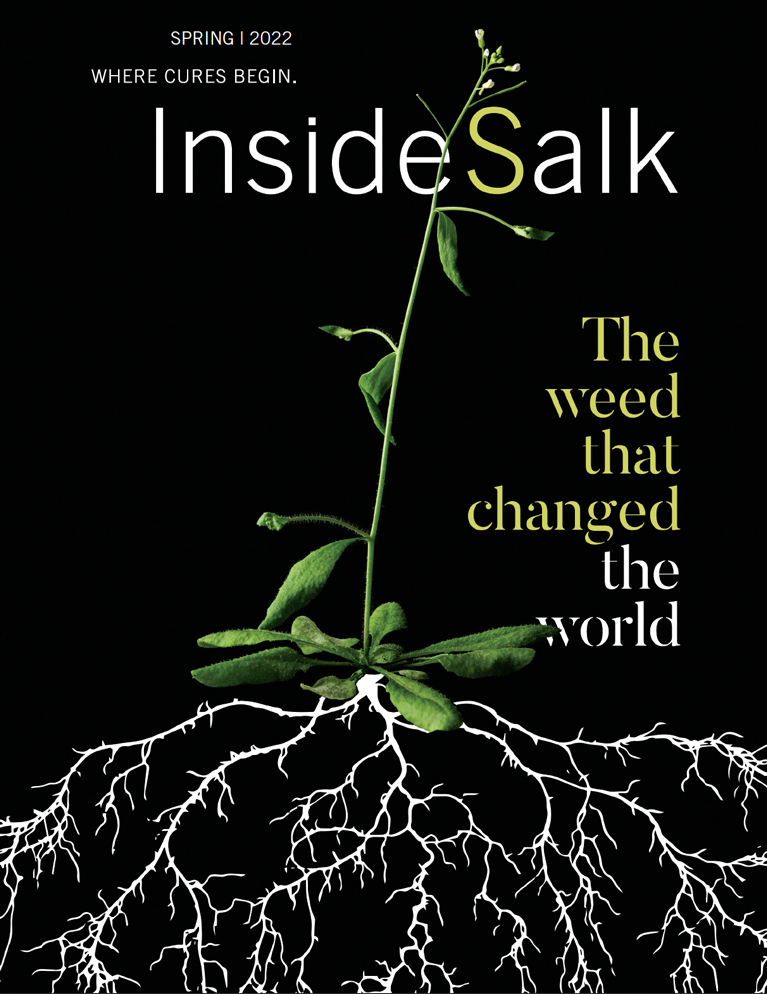
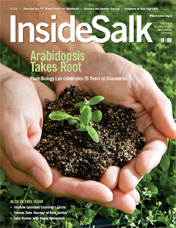
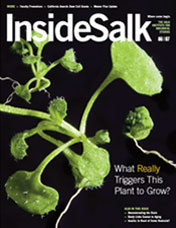
Nearly everything you know about plants was first discovered in a plant you’ve likely never heard of. Arabidopsis thaliana, also known as thale cress, is a small, flowering weed that has been used by researchers for the last half-century to study plant growth and behavior. Despite this, many aspects of the Arabidopsis life cycle still remain a mystery.

Salk scientist Joseph Ecker, PhD, postdoctoral researchers Natanella Illouz-Eliaz, PhD, and Travis Lee, PhD, and colleagues have now established the first genetic atlas to span the entire Arabidopsis life cycle. The new resource, created using detailed single-cell and spatial transcriptomics, captures the gene expression patterns of 400,000 cells within multiple developmental stages as Arabidopsis grows from a single seed to a mature plant. The public atlas will be highly informative for future studies of plant cell types, developmental stages, and responses to environmental stress. Those findings will then help expand research and development in plant biotechnology, agriculture, and environmental sciences.


NATURE COMMUNICATIONS
08/2025

All DRII-ed up: How do plants recover from drought?

A plant’s number one priority is to grow—a feat that demands sunlight, nutrients, and water. If just one of these three inputs is missing, like water in a drought, growth halts. You might then think that at the end of that drought, the plant would jump right back into growing. Instead, its priorities shift.

When Salk scientist Joseph Ecker, PhD, postdoctoral researcher Natanella Illouz-Eliaz, PhD, and colleagues examined the Arabidopsis plant in the moments after drought, they discovered that immunity became the plant’s top priority. Using single-cell and spatial transcriptomics, they observed immune-boosting genes rapidly light up throughout the plant’s leaves. They then found that this supercharged immune response, dubbed drought recovery-induced immunity (DRII), also occurs in wild and domesticated tomatoes, suggesting that this prioritization of immunity is likely common across many important crops. Their findings could help scientists develop new crop varieties that are more resilient to drought and disease.

Sign up for our monthly newsletter.

Latest discoveries, events & more.