View flipbook
  Download current issue
  Archives
 Salk Institute
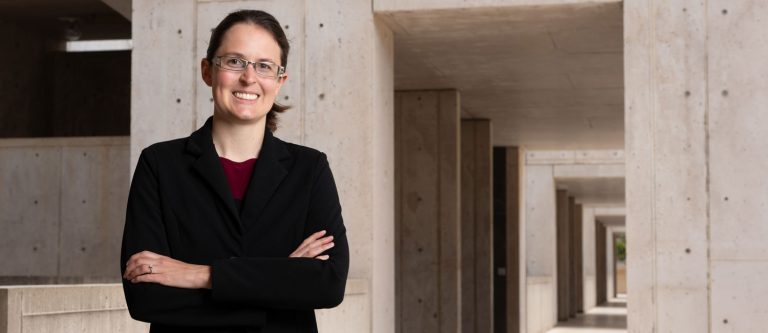
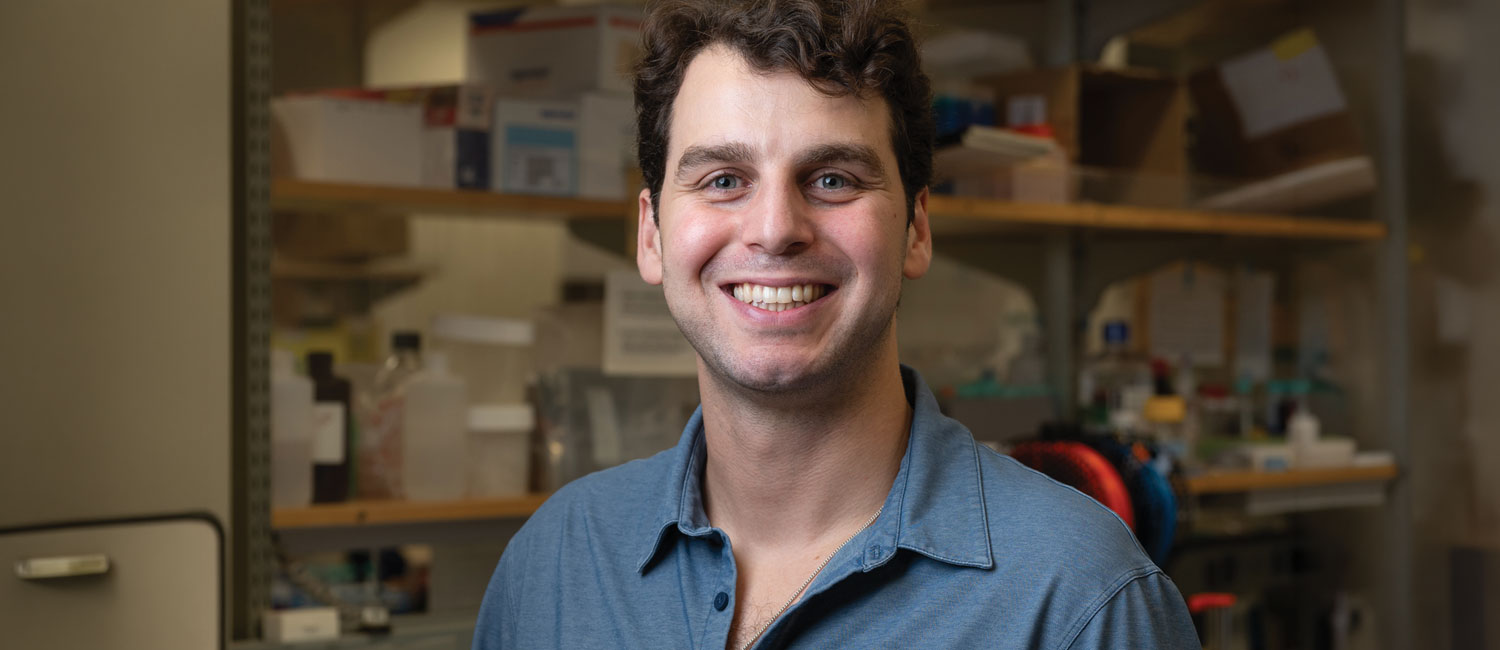
 Adam Farsheed, PhD, is a problem solver. His curiosity about the world is clearly that of an engineer, driven by mathematics and physics. But Farsheed is not all brains—he also leads with his heart, caring deeply for people and allowing those relationships to shape and inspire his path.
Farsheed works on building and improving brian organiods in Rusty Gage’s lab.
“My dad has a crazy life story,” says Farsheed. “In his freshman year at the University of Southern California, he became stranded with no money when his government back home in Iran—which his dad worked for—was overthrown.”
Farsheed’s father’s story broke his world open at an early age, pulling him away from the typically small world of adolescence. With time, his father dug himself out of the hole he had been dropped in, eventually starting his own software company.
“My dad’s story showed me a lot of life is luck. I just got luckier than people who did not have my starting point,” he says. “And because of that, I always try to help people as much as possible.”
Adam Farsheed
My biggest motivation is to mentor, teach, and make positive change in the world. I love my research endlessly, but giving back is where I find the most fulfillment. If I’m not doing that, I’m not doing enough.”
This lesson from his father’s life collided with another lesson from his mother, a psychology professor: Do not immediately go from undergraduate to graduate school. With his mechanical engineering degree nearing its end, a Teach for America representative reached out, and Farsheed’s detour from academia was decided then and there.
Farsheed spent two years teaching seventh-grade math—years he still recalls as “probably the most impactful thing that I have done in my life.” Midway through year two, Farsheed knew he wanted to return to school himself. But before he left, he had a devastating obligation; to let his students know their school would be shutting down.
“It was baffling,” he shares, “and, from then on, I knew I wanted to make large, systematic changes to our education system. And the best way for me to do that is to become a university professor.”
This goal made Farsheed especially excited to work for Rusty Gage, PhD, at Salk, “because one thing you learn very quickly about Rusty is that everyone who works for him says he is an amazing mentor. I knew he could teach me the skills to flourish in his lab, then also can teach me how to be a good professor.”
Farsheed made his way to San Diego from Houston, where he completed his PhD in bioengineering. He hadn’t expected to be so lucky as to wind up back in California for his postdoctoral years. “My wife is from San Diego, and I have her to thank for pushing me to explore options here,” he says. “Without her, I probably would have never found Rusty.”
Gage is a neuroscientist who has pioneered the use of organoids, miniature 3D models of organs that can be used to study their real-life counterparts. The lab’s endeavor to build and improve brain organoids reeled Farsheed in.
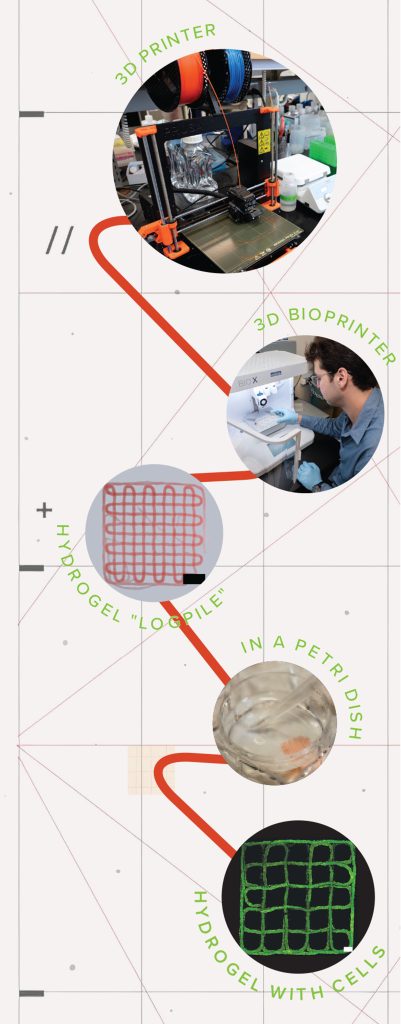
“I had developed this technology to 3D print hydrogels, which are a Jell-O-like class of materials that cells like to grow in,” explains Farsheed, “and I thought there was a really great use case for them in neuroscience.” Farsheed has lots of creative ideas for how his hydrogels can help neuroscientists ask and answer new questions.
First, he is trying to grow much larger brain organoids. Current brain organoids are often on the cubic millimeter scale—just a fraction of the size of a mouse brain. Using 3D printed hydrogels, Farsheed is creating brain organoids on the centimeter scale, striving to match the size of primate brains.
Second, he is working to recreate the circuitry of the brain. Rather than a big ball of cells that represent a “general brain,” Farsheed envisions growing specific brain regions one at a time, then connecting them to create a much more accurate human brain model.
And finally, he is attempting to make a vascularized brain organoid. “There is a big interest in creating blood-brain barrier models,” says Farsheed. The blood-brain barrier is a special feature of the brain vasculature that acts as a filter between the blood stream and brain, gatekeeping everything that goes in or out. “I am trying to create a human blood-brain barrier model using my bioengineering techniques.”
Once his new and improved models become a reality, Farsheed wants to hand them over to his neuroscientist lab mates for questioning.
“One thing I learned is that my engineering brain and the biologists’ brains work very differently—I’m trying to build solutions, whereas they are much better at discovering what problems are worth solving,” says Farsheed. “And actually, it is kind of a superpower to have a different background than everyone else, because I feel like I can see things that no one else can see, and vice versa.”
This interdisciplinary exchange of ideas is especially prevalent at Salk, where scientists collaborate constantly to answer life’s biggest questions. Farsheed says that Salk’s commitment to science, as seen in its cutting-edge core facilities, and emphasis on education, as seen through programs like the Heithoff-Brody High School Summer Scholars Program, remind him that Salk and San Diego were the right choice.
“My biggest motivation is to mentor, teach, and make positive change in the world,” says Farsheed. “I love my research endlessly, but giving back is where I find the most fulfillment. If I’m not doing that, I’m not doing enough.”