View flipbook
  Download current issue
  Archives
Strengthening Salk’s faculty in the fields of cancer, Alzheimer’s, epigenetics, and AI
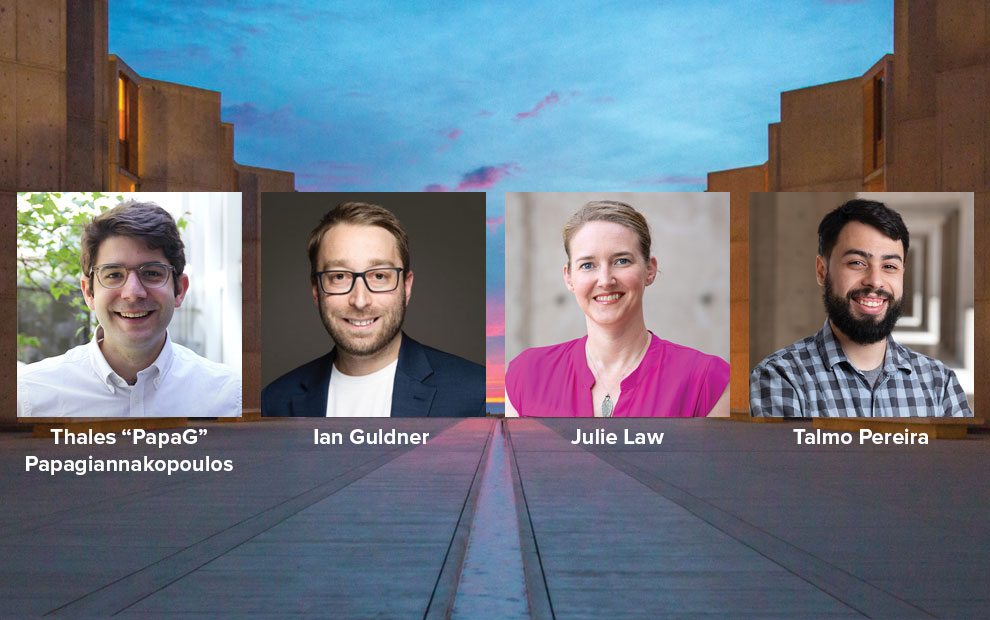
The Salk Institute welcomed several new faculty members and recognized a key promotion.
Every medical advance begins with a question no one has yet answered. This spring, the Salk Institute welcomed several new faculty members and recognized a key promotion, and each scientist brings a distinct set of questions that will deepen Salk’s foundational research in cancer, Alzheimer’s disease, epigenetics, and artificial intelligence.
Thales “PapaG” Papagiannakopoulos, PhD, will join Salk as a professor in September 2026, coming from the NYU Grossman School of Medicine. His central question: How do tumors adapt when threatened? In addition to multiplying, cancer cells shift how they use energy, reshape the immune environment around them, and even communicate with the nervous system in ways that drive symptoms like fatigue and weight loss. In two recent studies published in Nature, PapaG’s team showed that disrupting specific proteins reduced lung and pancreatic cancer in laboratory experiments, pointing toward promising new therapeutic strategies. At Salk, PapaG will add momentum to the Institute’s National Cancer Institute-Designated Cancer Center and forge new collaborations across the Institute’s cancer, metabolism, immunology, and
neuroscience programs.
Ian Guldner, PhD, will join Salk as an assistant professor later in 2026, with his recruitment made possible by a gift from the Ray and Dagmar Dolby Family Fund. His question has profound implications for an aging population: What goes wrong inside brain cells years before Alzheimer’s disease becomes apparent? Guldner studies the cellular machinery that keeps neurons healthy over a lifetime and investigates how the brain’s immune cells change as we age. In a first-author paper published this year in Nature, he described how aging causes certain proteins from neurons to accumulate inside the brain’s resident immune cells, a finding that opens a new window onto the earliest stages of cognitive decline.
Julie Law, PhD, has been promoted to full professor in recognition of her discoveries in epigenetics, the chemical modifications that organize DNA and regulate which genes are active without altering the genetic code itself. Her most recent work revealed that certain proteins and DNA sequences can direct entirely new epigenetic patterns, a significant conceptual advance. Law also explores how plants can be engineered to better withstand environmental stress, contributing to Salk’s Harnessing Plants Initiative.
Talmo Pereira, PhD, has joined the faculty as an assistant professor after serving as a Salk Fellow. A computational neuroscientist, Pereira builds AI tools that analyze how living things move as a window into how they work. His open-source software, SLEAP, is now used by tens of thousands of researchers in more than 90 countries studying everything from organelles to whale sharks.
Together, these four scientists embody what makes Salk unique: a community where curiosity drives the work, collaboration is the default, and the most fundamental questions are always worth asking.