View flipbook
  Download current issue
  Archives
 Salk Institute
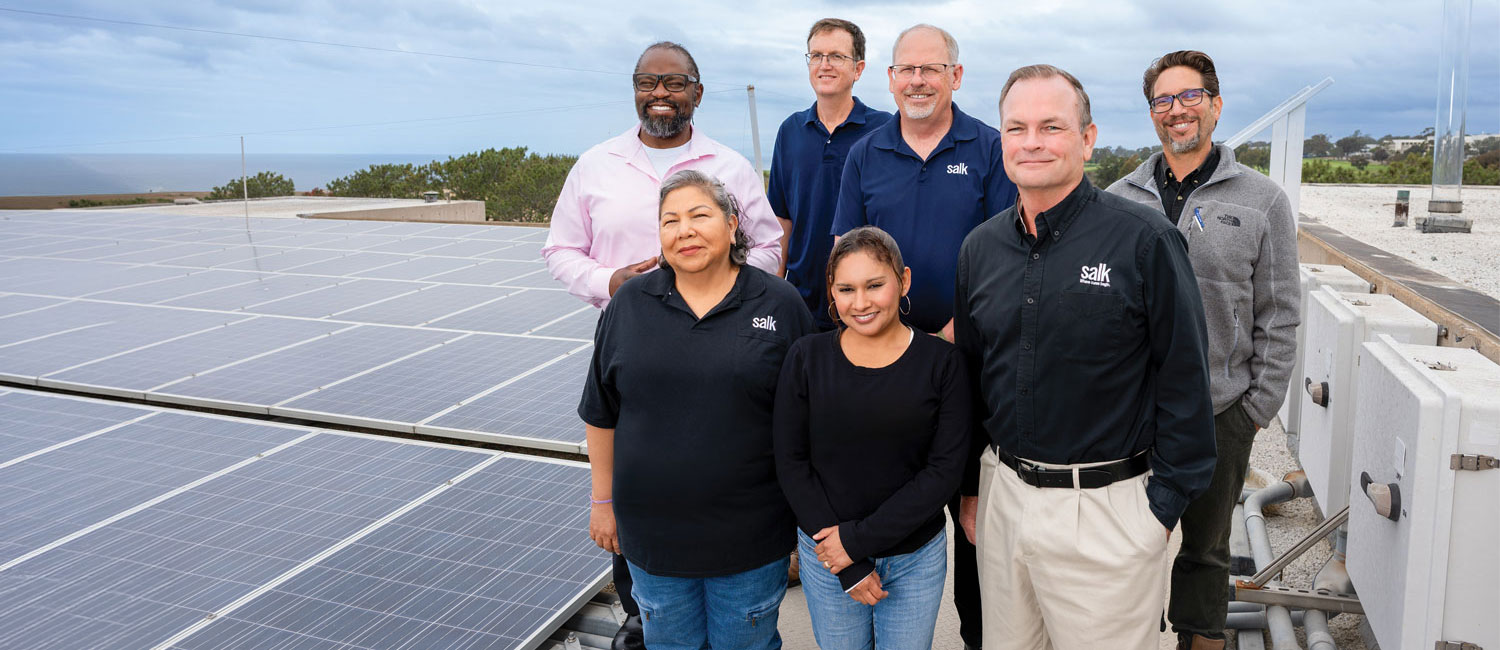
 Ball and his team maintains Salk’s campus and helps create the conditions for discovery.
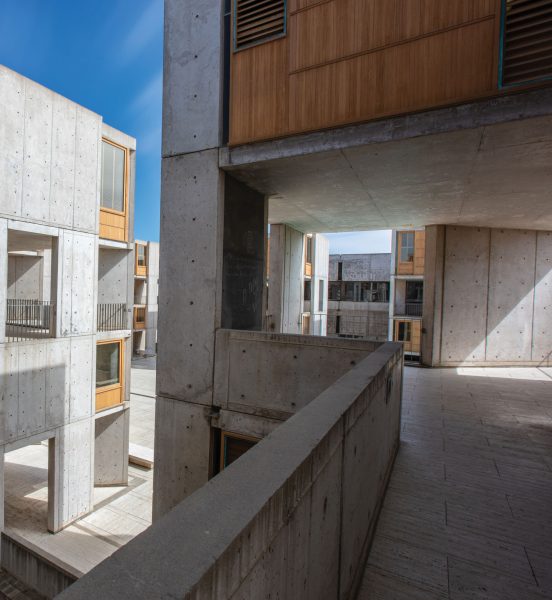
Every day, soft morning light washes across Louis Kahn’s concrete walls as the Pacific fog lifts over the courtyard.
From above, the campus appears still, its laboratories quiet beneath the steady rhythm of the River of Life water feature flowing toward the horizon.
But beneath that calm exterior, the Institute is already awake.
At Salk, discovery never truly stops. Neither do the systems nor the people that sustain it.
Air-handling systems circulate air through laboratories with microscopic precision. Chilled water moves through underground infrastructure. Engineers monitor temperatures critical to sensitive experiments. And the overnight watch teams and custodians complete their final rounds before researchers begin arriving for the day.
Tim Ball, executive director of Facilities Services and Operations, describes Salk as a living organism.
“Power. Water,” Ball says. “That’s the life of the Institute.”
The Central Plant and the central meaning
Ball wasn’t actively looking for a new job when he was recruited to Salk nearly 18 years ago. At the time, he was working in Long Beach, commuting from Oceanside, and raising his young son. A former colleague encouraged him to consider the opportunity.
Before arriving at Salk, Ball had spent years working in higher education facilities operations, developing expertise that extended far beyond building maintenance. He had experience managing complex campus infrastructure systems, long-term capital planning, and utility operations, and served on a statewide team negotiating power procurement strategies for California institutions.
But there is nothing like Salk’s intricacies and high-stakes maintenance. That’s what ultimately drew him in.
As head of Salk’s Facilities Services team, Ball stewards one of the world’s most iconic research campuses and its 1960s infrastructure, preserving its history while preparing it for the future.
Maintaining Salk’s campus and its underground labyrinth is a unique task for a uniquely skilled team. Deep beneath the campus, the central plant—the mechanical heart of the Institute—distributes cooling, heating, steam, air, gas, and power across Salk’s laboratories and research facilities.
“It’s like restoring an old ’57 Chevy,” Ball says. “You get excited about it, it means something to you, and it’s a part of history… that’s an opportunity to make it better.”
But for Ball, the work has never simply been about maintaining buildings or upgrading infrastructure.
“It’s more than just taking care of the place. It’s basically inspiring the science, creating the envelope where miracles can happen.”
Tim Ball
Years ago, as Ball sat with his father during the final stages of cancer, he remembers hearing him say, “My son works for Salk. They’re gonna find a fix for this someday.”
“That’s why I’m here,” Ball says.
The moment shaped the way he sees his role at the Institute today—not simply overseeing operations, but also helping create the conditions for discovery.
But what does that look like?
Day-to-day commitment
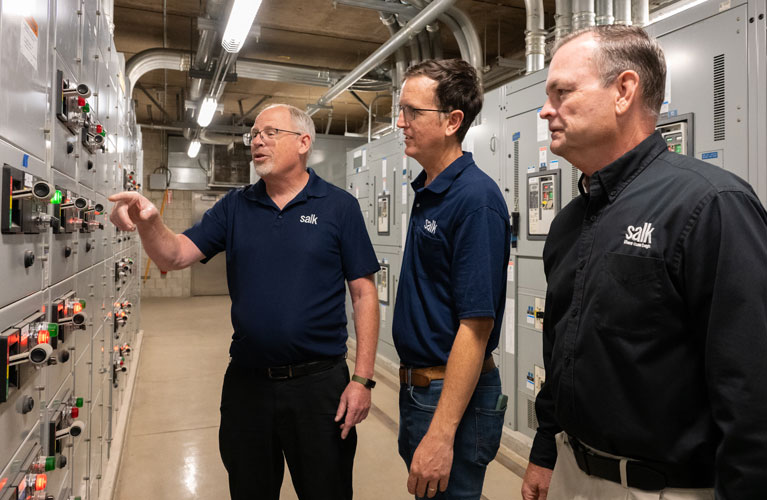
Facilities Services consists of 48 team members supporting the campus around the clock. On average, the department receives roughly 15,000 work orders each year—everything from urgent infrastructure repairs to the day-to-day operational needs that keep research moving uninterrupted.
“We have 756 work orders in process currently,” Ball explains.
Tom Bauer, assistant director of Facilities Services, has spent 36 years working inside the Institute’s mechanical core.
“Most of my time is in the shadows trying to make sure everything that everybody appreciates is still working,” Bauer says.
Over the decades, Bauer has responded to storms, floods, power outages, and infrastructure failures. He remembers moments spent managing floodwater while also restoring electrical systems and protecting laboratory freezers holding years of scientific work.
“Science doesn’t stop,” Bauer says. “They need it, they need it now.”
A burst pipe or mechanical failure can happen in any building. At Salk, however, the stakes are different. A seemingly routine facilities issue could jeopardize experiments, specimens, years of potentially life-saving data, or historic infrastructure. For Facilities Services, every response carries that responsibility.
Mike McClelland, trades supervisor, has spent roughly 17 years at Salk, beginning as a central plant watch engineer responsible for monitoring laboratory freezers, incubator temperatures, mechanical systems, and equipment alarms while most of the campus is asleep.
“I’d have around seven miles under my belt on an average day,” McClelland says of his overnight rounds through the campus. Ball’s experience is similar. “I go through three pairs of work shoes a year,” he says.
Even after decades at Salk, the Institute can still surprise McClelland.
“The other day, I went into a little closet shaft and thought, ‘I’ve never been in this room before,’” he says. “I don’t say that very often anymore.”
Facilities Services knows Salk inside and out and understands not only the systems, but also the rhythms of the researchers working around them.
“Sometimes we’ll adjust our schedule and come in at 4 a.m., if that’s what’s needed,” McClelland says.
When Facilities Services is not working around the science, they’re working with the science, setting up labs, ensuring new technology can be supported, and collaborating with scientists on sustainability initiatives.
Sustainability and Stewardship
For Facilities Services, sustainability is as much about stewardship and efficiency as it is about honoring the Institute’s long history of innovation and forward-thinking design.
Many of Salk’s sustainability principles, Ball notes, were embedded into the campus long before sustainability became standard practice.
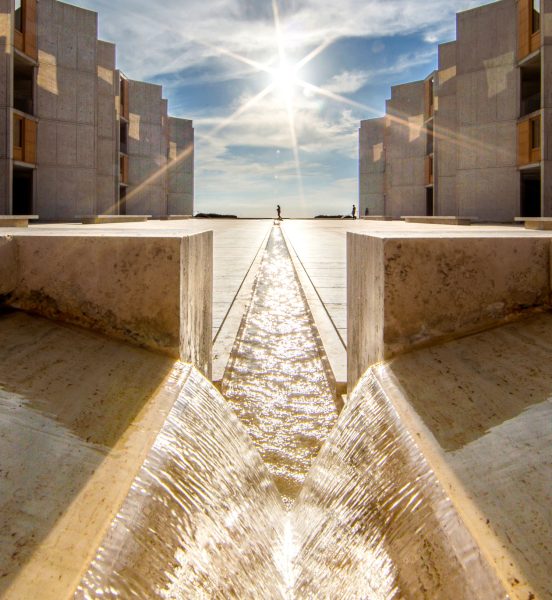
Salk’s iconic River of Life water feature, bisecting the Courtyard, is sustained through a 250,000-gallon underground cistern that captures rainwater from across the campus watershed. Louis Kahn’s original design also incorporated large light wells that allow natural sunlight to reach deep into the laboratories below to reduce the need for artificial lighting.
Even the Institute’s orange groves and grassy areas serve a dual purpose, functioning as landscape features and natural cooling elements for infrastructure beneath the campus.
Today, Facilities Services continues building on that forward-thinking foundation through modern sustainability initiatives designed to improve efficiency, maintain uninterrupted research, and reduce operational costs.
“If you can get enough savings out of it but not affect the research, that’s the key point,” Bauer says.
In an ongoing multiyear project, Facilities Services has installed motion-sensor LED lighting systems that reduce unnecessary energy use without disrupting researchers as they move between experiments.
“People are doing their science, holding their samples,” McClelland says. “They’re not worried about turning the switch off.”
And the Institute’s LED transition has already saved roughly $350,000 annually in electricity costs, along with an additional $27,000 in yearly lamp replacement expenses.
Solar arrays above the laboratories generate approximately 500 kilowatts of electricity, offsetting an estimated 10 to 15 percent of Salk’s total energy demand while helping power the systems that keep the Institute operating around the clock.
Through a combination of operational efficiencies, renewable energy production, and carbon offset procurement, the Institute has also achieved carbon neutrality.
“It’s about striking the balance between understanding the old and incorporating the new,” Ball continues, “while preparing Salk for further innovation and expansion.”
The People
For Facilities Services, sustaining the Institute is about more than just maintaining the infrastructure. They also preserve the knowledge and culture required to keep those systems running for the long term.
As older equipment is modernized and new technologies are introduced, Facilities Services faces another responsibility: passing decades of institutional knowledge on to the next generation of employees.
That philosophy echoes one of Jonas Salk’s guiding beliefs: “Our greatest responsibility is to be good ancestors.” Together, Ball, Bauer, and McClelland represent nearly 80 years of institutional knowledge at Salk.
Bauer now spends much of his time mentoring early-career Facilities staff.
“You can’t train caring,” Bauer says. “That’s got to be ingrained in that person.”
Bauer describes his role as part of something much larger than himself.
“I am part of the shoulders that other people stand on to make life better for everybody else,” he says.
For Ball, sustainability ultimately extends beyond infrastructure upgrades or energy savings.
“This isn’t your everyday facilities job,” Ball says. “You’re here for the inspiration, the meaning, and the longevity.”
At Salk, that longevity depends on people quietly sustaining the systems that breathe life into the campus and set the stage for discovery.